If you use ChatGPT every day, the free tier will eventually get in your way. If you ask it a few questions a month, it probably never will. This is about working out which side of that line you’re on.
ChatGPT now has more tiers than Free and Plus. There’s an $8 Go plan below Plus and two Pro tiers above it, at $100 and $200. Most people still face the same single decision, though: is free enough, or is it time to pay $20?
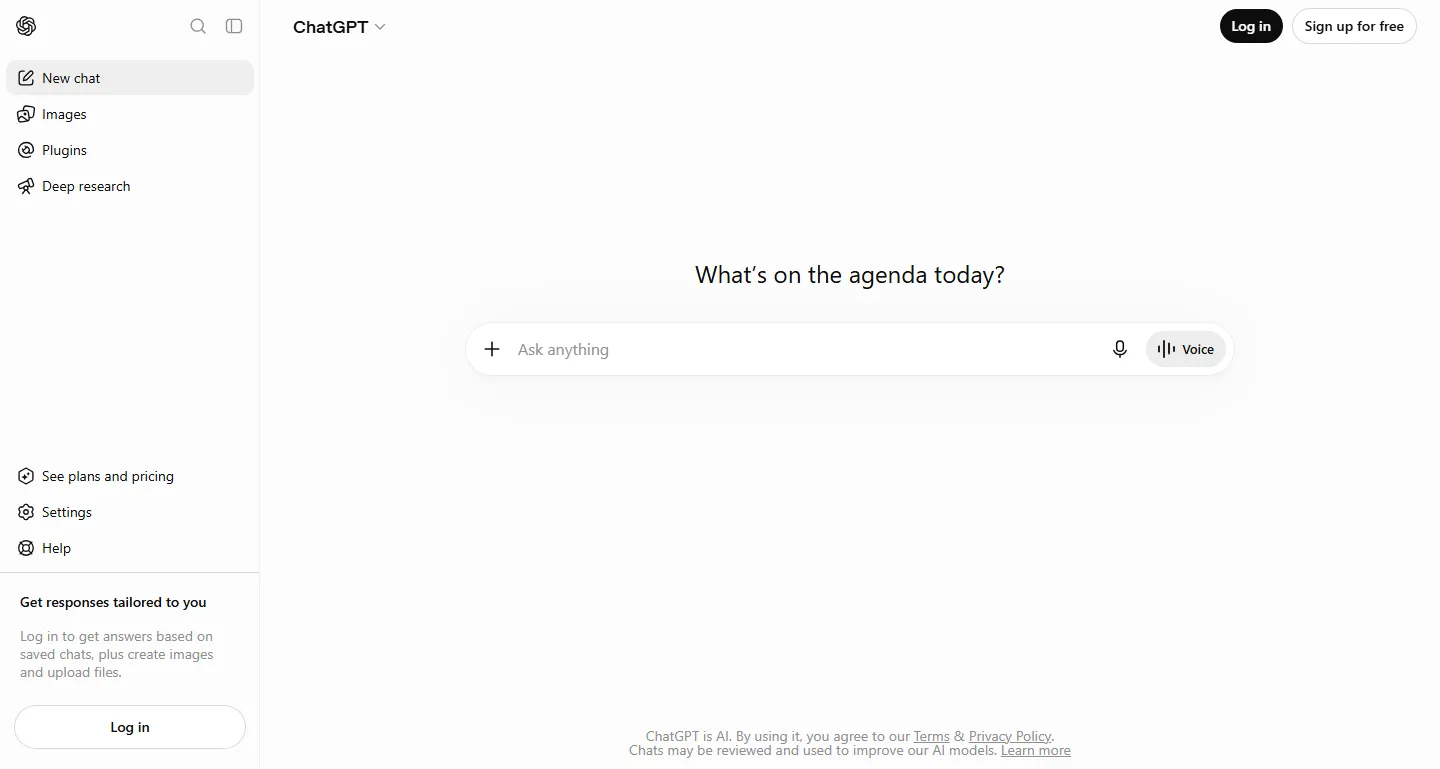
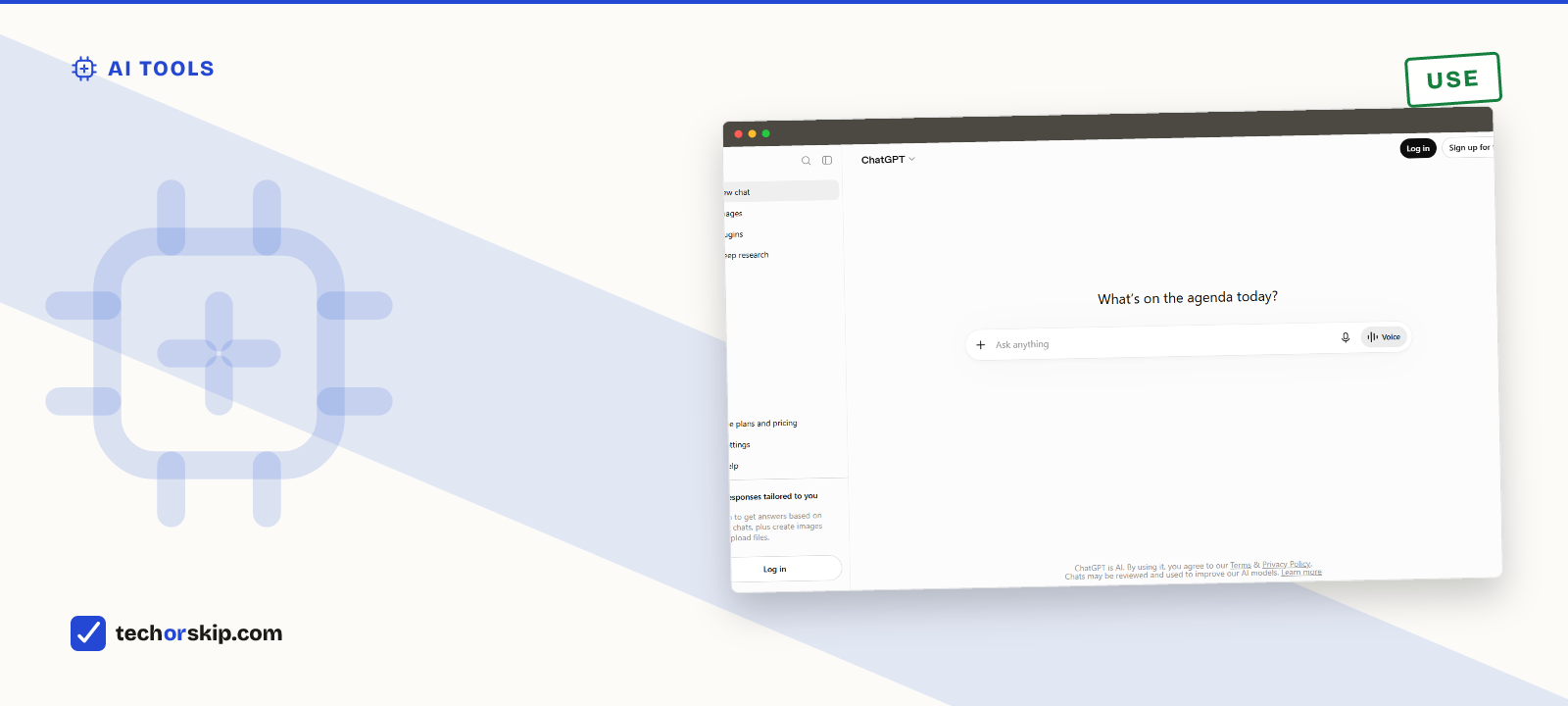
The chat screen every ChatGPT user sees first, free or paid. The differences show up once you start typing.
How we compared
Plan prices and tier structure come from OpenAI’s own pricing page and product announcements, checked in July 2026. Coverage of the ads rollout comes from reporting by Axios and CBS News, both named inline where their reporting is used.
One honest gap sits in the middle of this article, and it’s worth naming up front: OpenAI does not publish hard message limits for any tier. Nobody outside the company can give you an exact number that stays true for a month. Any article that quotes a precise free-tier message cap is reporting one person’s observation on one day, or repeating someone else’s. Everything below treats the caps as directional rather than fixed.
First, check which tier you’re actually on
Confirm what you have before deciding anything. It’s easy to think you’re on Free after a trial ended, or to assume Plus is still active when a promotional period lapsed months ago. Open the account or settings menu inside ChatGPT and look at the billing page. That’s the one screen where marketing language doesn’t apply.
Where the free tier actually limits you
Three limits matter, and only one of them is about message counts.
Ads arrived. This is the change most people haven’t caught up with. Axios reported that OpenAI began showing ads to US users on the Free and Go tiers in February 2026, with Plus, Pro, Business, and Enterprise staying ad-free. CBS News reported the same rollout, describing ads that appear beneath responses when there’s a relevant product. If an uninterrupted screen matters to you, that alone is part of what $20 buys.
The default model is lighter. Free runs a less capable default than paid tiers get, and OpenAI moves which model sits where with each release. Plus is the first tier that reliably puts you on the current flagship.
Message caps arrive without warning. Free gives you a rolling allowance rather than a clean daily reset, and hitting it drops you to a lighter fallback model rather than cutting you off entirely. OpenAI doesn’t publish the number, and it has changed more than once. Image generation and Deep Research run out faster than plain chat does, which is why people usually notice the ceiling mid-project rather than mid-conversation.
If Deep Research is the feature you actually lean on, our guide to verifying AI research citations covers the accuracy risks that come with any tier, paid or free.
Homework help, occasional emails, settling dinner-table arguments? Free is fine. Daily drafting, coding, or back-to-back research? Those three limits will interrupt real work, sometimes twice in one sitting.
The $8 Go plan’s awkward middle ground
Go sits between Free and Plus and looks like a cheaper fix for the same problems. It mostly isn’t. It raises usage limits without giving you the flagship model or the full Plus feature set, and per the ads reporting above, Go users still see ads. It’s closer to “Free with more room” than “Plus for less.”
OpenAI has since rolled Go out worldwide, so the availability caveat that applied at launch no longer does. The pricing logic still bites, though. If you’re reasonably sure you’ll want Plus eventually, Go is $8 a month spent delaying the decision rather than making it. Pay it for six months and you’ve spent $48 to still not have the thing you wanted.
Go earns its place in exactly one case: your only complaint about Free is running out of messages, and you genuinely don’t care which model answers.
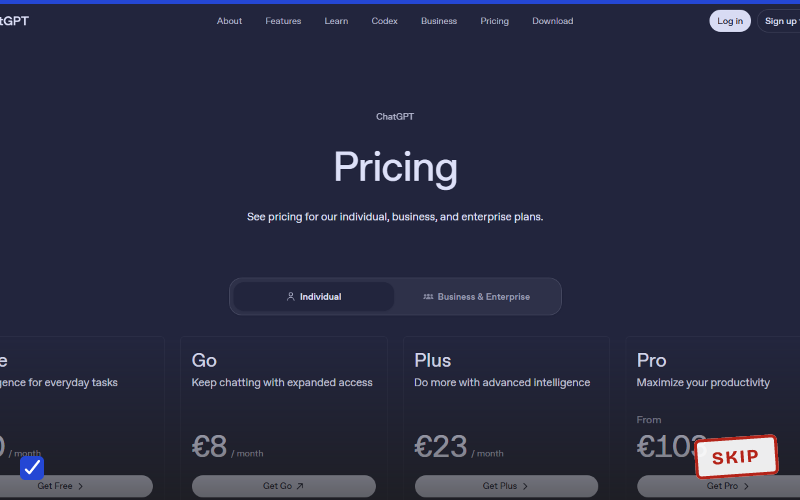
Pricing
| Plan | Price | Key limits |
|---|---|---|
| Free | $0/mo | Lighter default model, rolling message cap, ads on some answers in the US |
| Go | $8/mo | Higher limits than Free, ads still shown, not the flagship model |
| Plus | $20/mo | Flagship model access, higher limits, Codex, no ads |
| Pro | $100 or $200/mo | Much higher usage on the flagship models, two tiers |
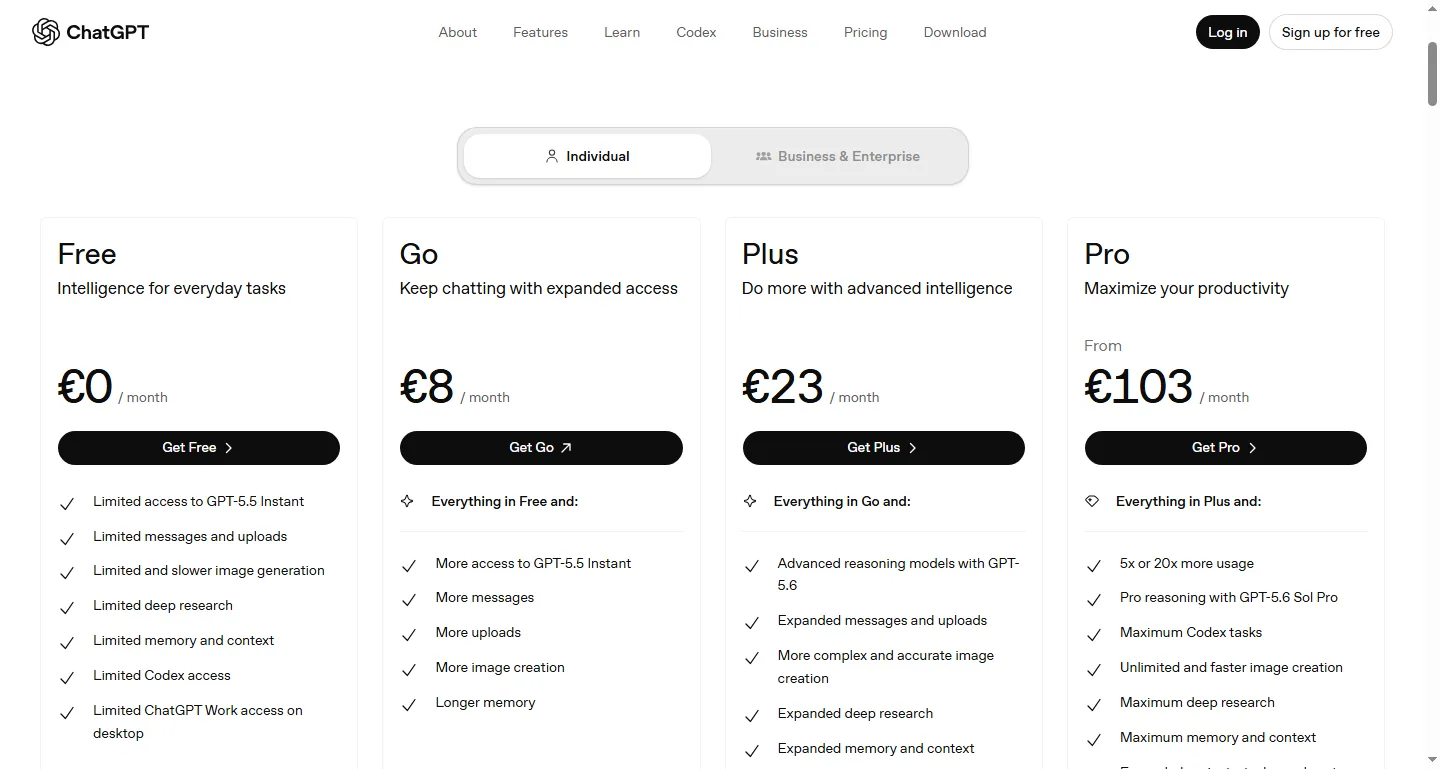
OpenAI’s own pricing page. It renders amounts in your local currency, so check the page for your own country rather than trusting a figure from an article.
When Plus actually pays for itself
Twenty dollars a month is $240 a year. That only makes sense if the free tier costs you more than that in wasted time: waiting out rate limits, restarting on a lighter model, switching tools mid-task.
Here’s the arithmetic. $20/month is about $0.66 a day. If a free-tier limit costs you even five minutes on an average workday, and you value your time at anything near minimum wage, Plus has paid for itself before lunch. The math only breaks down when those interruptions are rare, which for a genuinely occasional user, they are.
In practice the break-even shows up for people using ChatGPT as a daily work tool. Drafting several documents. Long coding sessions. Research that needs six prompts in a row. Hit the cap more than once or twice a week and the time you lose working around it is worth more than the subscription.
If your use is lighter than that, free isn’t a downgrade in any way that matters. You’re seeing a lighter model on questions where it wouldn’t have changed the answer. For whether ChatGPT is even the right tool to pay for, our three-way comparison with Claude and Gemini covers that first question.
Worth it for
- Free covers casual, occasional use with no real downside
- Plus removes the three interruptions that actually break a work session: rate limits, the fallback model, and ads
- Cancelling takes effect immediately with no contract
Skip it if
- Plus is a recurring cost that idle users forget to cancel
- OpenAI publishes no hard limits, so you cannot calculate in advance whether you would hit them
- Go looks like a compromise but leaves you short of the flagship model and still shows ads
Revisit this decision every few months regardless of which way you go. Free-tier limits, Plus features, and the plan lineup all changed more than once in the past year, and a “skip” today doesn’t necessarily hold in six months.
Alternatives
- Check whether you need ChatGPT specifically. Before paying for any AI subscription, read which AI subscription is actually worth paying for. The break-even math above applies to Claude and Gemini too.
- Stay on free tools entirely. If your use is a handful of quick questions, a genuinely useful free AI tool may cover you without any subscription.
- Vet what you add to your browser. If you’re installing ChatGPT-adjacent extensions, free or paid, check how to vet AI browser extensions first. Permissions matter more than your subscription tier.
Verdict
USE. Hit free-tier limits more than twice a week and Plus pays for itself in recovered time, with ad-free flagship access worth the $20 on its own for daily users.
Everyone else should stay free and revisit only when the limits start costing something real, rather than being mildly annoying once a fortnight.
Common questions
Is the free version of ChatGPT good enough?
For occasional use, yes. Free covers homework help, quick emails, and casual questions without hitting a real wall. What it doesn’t give you is the flagship model by default, and OpenAI began showing ads to US free-tier users in February 2026. Daily drafting, coding, or research is where the free tier’s rolling message cap and lighter default model start to cost you real time.
Is ChatGPT Plus still worth it?
Yes, for daily users. At $20 a month, Plus removes the three things that actually interrupt a work session: rate limits, the fallback model, and ads. The math works out to about $0.66 a day, so if free-tier friction costs you even five minutes on an average workday, Plus has already paid for itself.
Is ChatGPT Go worth it or should I get Plus?
Go is $8 a month and sits between Free and Plus, but it keeps ads and skips the flagship model, so it’s closer to “Free with more room” than a cheaper Plus. It only makes sense if your single complaint about Free is running out of messages and the model that answers doesn’t matter to you. If you’re likely to want Plus eventually, Go is money spent delaying that decision. Our dedicated ChatGPT Go vs Plus comparison covers the full pricing breakdown and who Go actually suits.