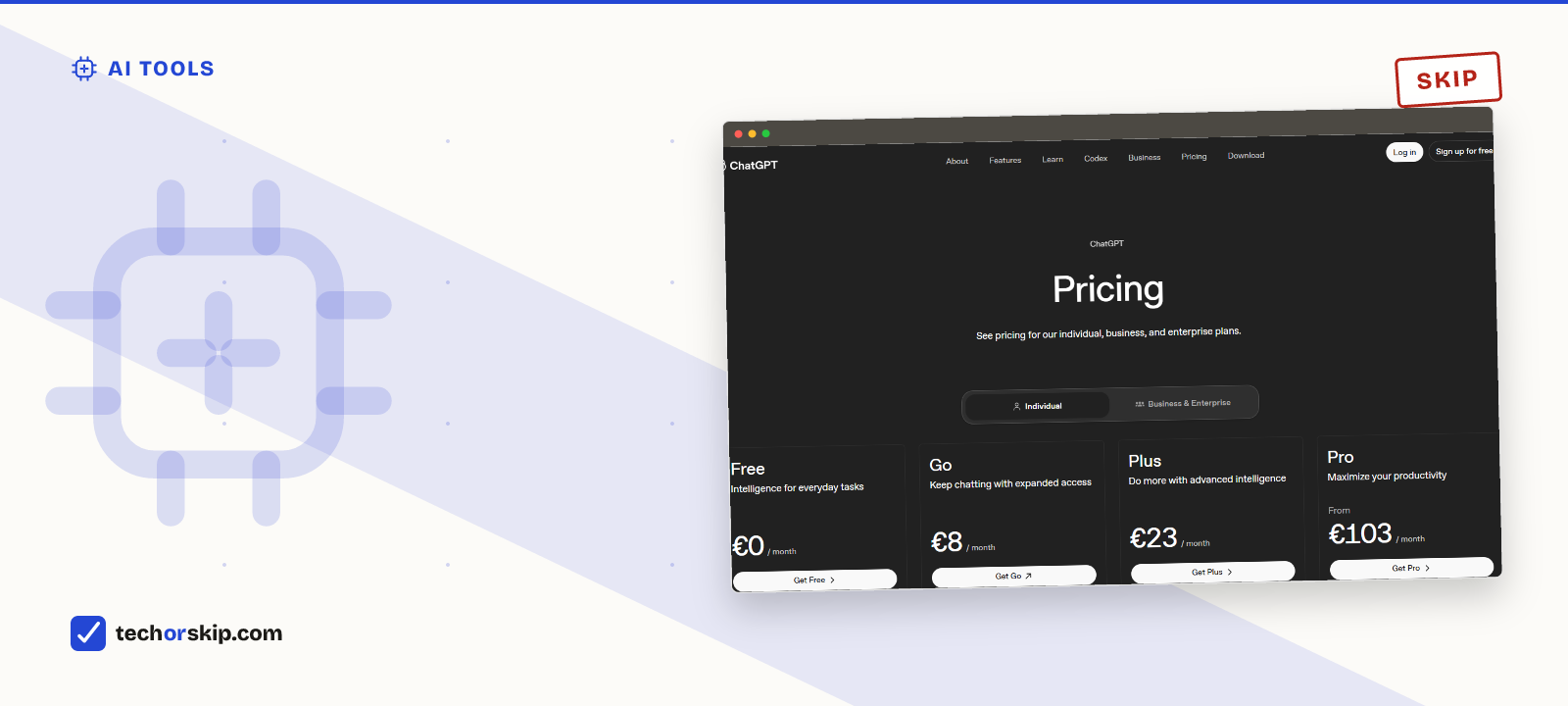
Skip Go. It’s $8 a month for higher limits on ChatGPT’s standard model, but it keeps ads and never gives you the flagship model that Plus does. If you’re actually choosing between three tiers, the real decision is Free versus the $20 Plus plan. Go is the option in the middle that solves the least.
That’s the blunt version. The nuance is that Go does raise the ceiling that trips up heavy free users, and for one specific kind of user, that’s genuinely enough. The rest of this is about figuring out which one you are.
How we compared
Pricing and tier structure come from OpenAI’s own pricing page and its blog post announcing Go’s global rollout, both checked in July 2026. The ads rollout is reported by Axios and CBS News, named inline wherever their reporting shows up here.
Nobody outside OpenAI publishes an exact daily message count for any tier, and OpenAI itself doesn’t either. Treat every specific number below as directional. It’s a description of the current shape of the deal, not a ceiling you can plan a workday around.
What Go actually adds over Free
OpenAI’s own announcement is specific about the multiplier, even if it won’t give you a base number to multiply. It describes Go as delivering “10x more messages, file uploads and image creation than the free tier” while staying on the standard model rather than the flagship one. When Go first launched in India, Nick Turley, OpenAI’s head of ChatGPT, used almost the same language: 10x higher message limits, 10x more image generation, 10x more file uploads, and 2x longer memory than free.
Ten times an unpublished number is still an unpublished number. What’s concrete is what doesn’t move: Go runs the same tier of model as Free. It just lets you send a lot more into it before you hit a wall.
Go has also gone from a regional trial to a global plan. OpenAI’s post confirms it’s “now available worldwide,” expanded from its original India launch to more than 170 countries. Price scales with local purchasing power, so $8 is the US number specifically, not a flat global rate.
The two gaps Go only half closes
Every ChatGPT tier above Free closes two gaps. Go only gets one of them partway.
Ads are the first gap. Axios reported that OpenAI began showing ads to US users on the Free and Go tiers in February 2026, describing units that appear beneath a response when there’s a relevant product to show. CBS News covered the same rollout. Plus and every tier above it stays ad-free. Go doesn’t.
The model is the second, bigger gap. OpenAI keeps reshuffling which model sits on which tier, but the pattern holds: Plus is the first plan that reliably runs the current flagship model by default. Go and Free share the lighter standard model. They just get different amounts of room to use it.
Put together, Go’s pitch shrinks fast. You’re paying $8 to type more into the same model Free already gives you, with the same ads underneath the answers. That’s a real fix if message volume was your only complaint. It’s not the upgrade most people picture when they hear “a paid ChatGPT plan.”
The real question: is the extra $12 worth it
Plus costs $20. Go costs $8. So the actual decision isn’t “should I pay for ChatGPT.” It’s “is the $12 gap between Go and Plus worth closing.” Framed that way, it’s a much easier question to answer honestly.
Twelve more dollars a month buys the flagship model, an ad-free chat, and Plus’s broader feature set on top of Go’s higher limits. If you’re already willing to pay something, most people come out ahead finding the extra $12 rather than settling for a plan that only fixes volume. Go wins this comparison in exactly one case: $12 is a genuine stretch, and message count really is your one complaint.
Our full ChatGPT free vs Plus breakdown covers the Plus break-even math in more detail. It works out to roughly $0.66 a day, which pays for itself if free-tier friction costs you even a few minutes on an average workday.
Pricing side by side
| Plan | Price | Model | Ads |
|---|---|---|---|
| Free | $0/mo | Standard model, rolling cap | Yes, US rollout |
| Go | $8/mo | Standard model, ~10x Free's limits | Yes, per Axios/CBS |
| Plus | $20/mo | Flagship model, higher limits | No |
| Pro | $100 or $200/mo | Flagship models, much higher usage | No |
Who Go is actually right for
One group gets real value here: people who hit Free’s message ceiling constantly, don’t care which model answers, and won’t pay $20 under any circumstances. For that person, $8 buys genuine breathing room and nothing else needs to change.
Everyone else is better off picking a side outright. Casual users should stay on Free and keep the $8. Anyone who wants the flagship model, an ad-free chat, or Plus’s fuller toolset should skip Go and go straight to $20.
Worth it for
- Meaningfully higher message, image, and file caps than Free, per OpenAI's own figures
- Available in 170+ countries at $8/month, priced to local purchasing power
- A real fix for the single most common free-tier complaint: running out of messages
Skip it if
- Still runs the standard model, not the flagship one Plus gets by default
- Still shows ads on responses, the same as Free, per Axios and CBS reporting
- Sits close enough to Plus in spirit that most people are better off finding the extra $12
Revisit this every few months regardless of which plan you land on. OpenAI has changed the tier lineup, the model assignments, and the ad rollout more than once in the past year. A “skip” today isn’t guaranteed to hold in six months.
Check your own account before you decide
Two things about ChatGPT’s pricing change often enough that this article can’t give you a final number: your local price, and which model is running under the hood at any given moment.
Go’s $8 price is a US figure. OpenAI prices it against local purchasing power in other markets, so it’s meaningfully cheaper in some countries and roughly the same in others. Open the billing or upgrade screen inside your own account and check the number shown there before assuming $8 applies to you.
The model question matters just as much. OpenAI has reshuffled which model sits on which tier more than once since Go launched, and it will likely do it again. A comparison written in July 2026 can describe the pattern accurately. It can’t guarantee the exact model name six months from now. If model access is the deciding factor for you, check what Go and Plus are each running today, not what a review told you they ran on the day it published.
Alternatives
- Compare Plus against other flagship assistants, not just Go. Our ChatGPT vs Claude vs Gemini comparison covers whether ChatGPT is even the right $20 to spend.
- Check whether you need a paid AI tool at all. Which AI subscription is actually worth paying for covers the broader budget question before you commit to any tier.
- Stay free entirely if your use is light. A genuinely useful free AI tool may cover occasional use without a subscription of any size.
Verdict
SKIP Go for most people. It fixes message volume and nothing else, still carries ads, and still runs the lighter model. If $20 is affordable, Plus is the better $8-plus-$12 spend. If it isn’t, free already gives you the same model Go does, just with a lower ceiling.
Go earns its place only for the narrow case: constant free-tier limits, no interest in which model answers, and a hard no on $20.
Common questions
Is the free version of ChatGPT good enough?
For occasional use, yes. Free covers quick questions, homework help, and casual drafting without a real wall. What it doesn’t give you is the flagship model, and OpenAI began showing US free-tier users ads in February 2026. Daily use, coding, or long research sessions are where the rolling message cap starts costing real time.
Is ChatGPT Plus still worth it?
Yes, for regular users. At $20 a month, Plus removes the three things that actually interrupt a work session: rate limits, the fallback model, and ads. That’s about $0.66 a day, so if free-tier friction costs you even five minutes on a typical workday, Plus has already paid for itself.
Is Gemini Advanced worth it compared to ChatGPT Plus?
Roughly comparable on price. Google’s AI Plus plan lists at $19.99 a month per Google’s own pricing page, essentially matching ChatGPT Plus’s $20. Neither is a clearly better deal on cost alone. The deciding factor is usually which ecosystem you’re already in (Google Workspace versus everyday ChatGPT habit) rather than raw pricing.