Smart glasses stopped being a punchline sometime in the last eighteen months. IDC counted roughly 2.25 million display-less smart glasses shipped in the first quarter of 2026 alone, up 167% year over year. That single quarter nearly matched everything the category shipped in all of 2024.
Then June happened. Snap showed $2,195 Specs on the 16th. A week later Meta launched its own brand of glasses starting at $299. The gap between those two numbers is most of the confusion people have about this category.
So here’s the useful framing: there are two completely different products sharing one name. One is a camera and a speaker in a normal-looking frame. The other is a wearable screen. They cost different amounts, do different things, and deserve different answers.
How we compared
Prices and specs below come from the manufacturers’ own pages and from the launch coverage by CNBC, TechCrunch and Bloomberg in June and July 2026. Market figures come from IDC’s published tracker analysis. Everything is linked in the sources.
We haven’t worn these. What we can do is separate the marketing categories from each other, put the real prices side by side, and be specific about the tradeoff nobody’s ad mentions: you’re strapping a camera to your face in rooms full of people who didn’t agree to it.
The two products people keep confusing
| Model | Price | Display? | What it is |
|---|---|---|---|
| Meta Glasses (Adventurer, Fury, by Kylie) | From $299 | No | Camera, speakers, a button for Meta AI |
| Ray-Ban Meta (Gen 2) | From $379 | No | Same idea in the established Ray-Ban frames |
| Meta Ray-Ban Display | $799 | Yes, one eye | Small screen plus a neural wristband to control it |
| Snap Specs | $2,195 | Yes, both eyes | A standalone wearable computer for creators and developers |
The $299 tier: a camera and a speaker, not a screen
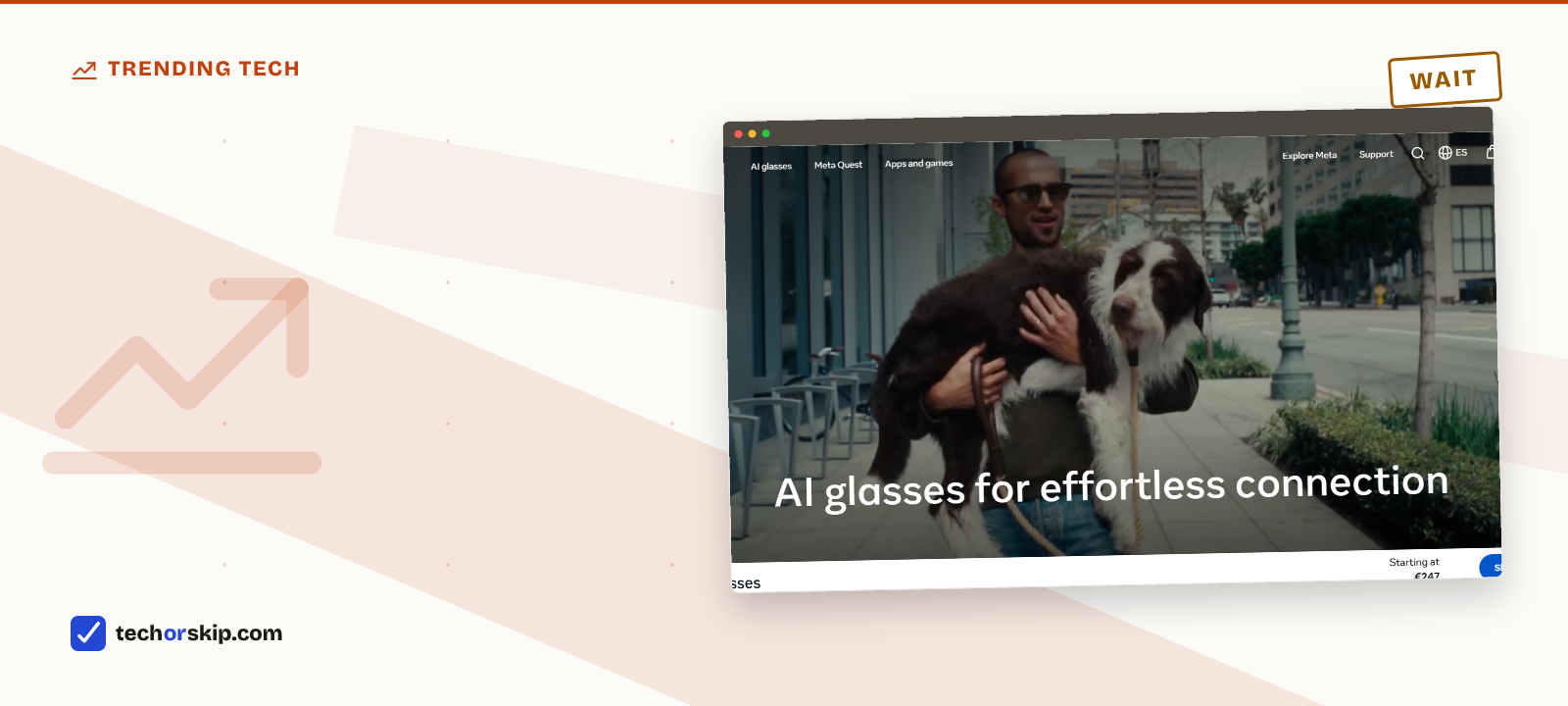
Meta launched its own-brand glasses on June 23, 2026 in three styles: Adventurer, Fury, and a slimmer oval designed with Kylie Jenner. They start at $299, and they’re the first Meta glasses that don’t carry a Ray-Ban or Oakley name on them.
They have no display. What they have, per TechCrunch’s launch coverage, is a camera, speakers near your ears, and a customizable button that triggers Meta’s assistant by default. Battery is over eight hours, with a charging case holding roughly 40 more.
That’s the honest description of this whole tier, including the $379 Ray-Ban Meta Gen 2. Hands-free photos and video. Music and calls without earbuds. Ask a question, hear an answer. If those three things sound worth $299 to you, this is a real product that works today, and the market agrees: Meta and EssilorLuxottica hold about 70% of shipments by IDC’s count, and Bloomberg reported in January that they were discussing doubling production after demand outran supply.
An always-on assistant with a camera and a microphone is asking for the same kind of trust as AI browser extensions with broad permissions: the convenience and the data access arrive as one package, not two.
What it isn’t: a screen, a phone replacement, or anything that overlays information onto the world.
The display tier: genuinely new, genuinely first-generation
The Meta Ray-Ban Display costs $799 and does have a screen, a small full-color panel in the right lens, controlled by a wristband that reads muscle signals from your hand. It launched at the end of September 2025, sold in person only at first, and demand outran the US supply enough that Meta delayed the international rollout.
Snap’s Specs sit at the far end. Announced June 16, 2026 at $2,195, preorders open, shipping in the fall in the US, UK and France. They project a much wider field of view than Meta’s display and can throw a virtual screen that scales from roughly a 24-inch monitor to a wall-sized one. Snap is pitching them as a standalone wearable computer rather than a phone accessory.
The catch is the same one every early wearable computer has had: about four hours of mixed use, with a charging case adding up to twenty. Four hours is a long movie or a short workday. It is not “wear them instead of your phone,” which is precisely what the marketing implies.
Reactions have split cleanly along that line. The form factor and field of view got real praise. The price and battery got real criticism. Both reactions are correct, which is usually what a first-generation product looks like.
The part the ads skip
You’re wearing a camera. Everyone around you is in frame, and most of them won’t notice the recording indicator, because it’s a small light on a pair of glasses in a bar.
This isn’t a hypothetical objection, and it’s not resolved by any of these products. It’s a social cost you’re choosing to impose on other people, and it lands differently in a gym locker room than on a hiking trail. Decide where you’ll actually wear them before you buy, not after.
The data question is separate and worth its own thought. These glasses feed a voice assistant run by a company whose business is advertising. If that gives you pause, the same instinct is worth applying to the settings on the phone they pair with. Our list of phone settings worth changing immediately is the shorter, cheaper version of the same cleanup.
Where the price is heading
IDC forecasts about 13.6 million display-less smart glasses shipping in 2026, growing to 27.3 million by 2030. More useful for a buyer: IDC expects the average selling price to fall from roughly $376 this year to around $229 by 2030.
So the category gets cheaper and more common. If you’re on the fence about a $299 pair, the fence is a fine place to stand. If you’re considering a $2,195 pair, you’re paying first-adopter rates for hardware that’s explicitly a first attempt.
Worth it for
- The $299 tier does what it claims: hands-free capture, audio, and voice answers
- Battery on the display-less models is genuinely all-day, over eight hours plus the case
- Prices are falling, and IDC expects the average to drop by roughly 40% by 2030
- The frames finally look like frames, which is why this generation sold at all
Skip it if
- Nothing at $299 has a display, and the marketing blurs that constantly
- Snap's four-hour battery undercuts the pitch that Specs replace a phone
- You are wearing a camera around people who did not opt in
- Display models are first-generation hardware at $799 and $2,195
Alternatives
- If hands-free audio is the actual appeal, decent earbuds do that for a fraction of the price and don’t point a lens at anyone.
- If you like the idea but hate the recurring-cost pattern that keeps appearing in wearables, read our roundup of viral tech products first. The smart ring section covers exactly that trap.
- If your interest is really the AI assistant rather than the glasses, the free AI tools worth using get you there on hardware you already own.
Verdict
WAIT, with one exception. The $299 to $379 tier is a finished product: if you specifically want hands-free photos and audio and you’re comfortable wearing a camera in public, buy those and enjoy them. Everything with a screen is a first-generation bet at first-generation prices, sold against a phone it cannot yet replace. Prices in this category are falling and the hardware is changing fast, which are both good reasons to let someone else buy version one.
Common questions
Are Meta Ray-Ban smart glasses worth it for everyday use?
For the $299 to $379 tier, yes, if hands-free photos, audio and quick voice answers are what you actually want. Per TechCrunch’s launch coverage, these have no display, just a camera, speakers and a button for Meta’s assistant, with battery life over eight hours plus roughly 40 more from the charging case. They’re a finished product doing exactly what they claim, which is why Meta and EssilorLuxottica hold about 70% of shipments by IDC’s count.
Should I buy smart glasses with a display, or skip it for now?
Skip it for now, unless you specifically want to be a first adopter. The Meta Ray-Ban Display costs $799 and Snap’s Specs run $2,195, and both are genuinely new hardware with a real tradeoff: Snap’s Specs get about four hours of mixed use before needing a charge, nowhere near enough to replace a phone despite the marketing angle. IDC expects average smart glasses prices to keep falling through 2030, which is a good reason to let someone else buy the first generation.