Your phone rings. It’s your grandson’s voice, panicked, saying he’s been in an accident and needs bail money wired now. Except it isn’t him. It’s three seconds of audio from a video he posted last month, run through a voice-cloning tool that needed no special skill to use.
This isn’t a rare, sophisticated attack anymore. The FTC reports Americans lost $3.5 billion to imposter scams in 2025 alone, and AI tools have made the most convincing version of these scams (a cloned voice, a faked video call, a fabricated official document) available to anyone willing to pay a few dollars a month for the software.
This article covers the current patterns law enforcement and researchers are actually tracking, with sources, and the one verification habit that defeats nearly all of them regardless of how convincing the fake gets.
Where these patterns come from
We didn’t clone anyone’s voice to write this, and we’d rather not encourage anyone else to. The patterns below come from the agencies that collect the reports: the FTC’s consumer alerts and 2025 imposter-scam data, and the FBI’s Internet Crime Complaint Center advisories. The detection tips come from ESET’s published guide to spotting deepfakes.
Those are all public documents, linked in the sources. Read them yourself if a specific scam is worrying you. Government scam alerts are unusually plain-spoken.
The pattern behind every version of this scam
The methods vary, but the structure barely does. AI just makes the performance more convincing than a scripted call center ever could.
| Scam pattern | What makes it convincing | What breaks it |
|---|---|---|
| Cloned "family emergency" voice call | Real voice, cloned from public social media clips | Hang up, call the person back on a number you already have saved |
| Fake bank or government caller | Spoofed caller ID, official-sounding scripts, urgency | Banks and agencies never ask you to move money to "protect" it |
| Fake fraud-recovery site (IC3 impersonation) | Looks like a real .gov complaint form | Type ic3.gov directly, never click a link from an unsolicited message |
| Deepfake job interview / recruiter | Real-time face-swap or cloned voice on a video call | Legit employers don't ask for money, gift cards, or bank info to onboard you |
The cloned-voice family emergency
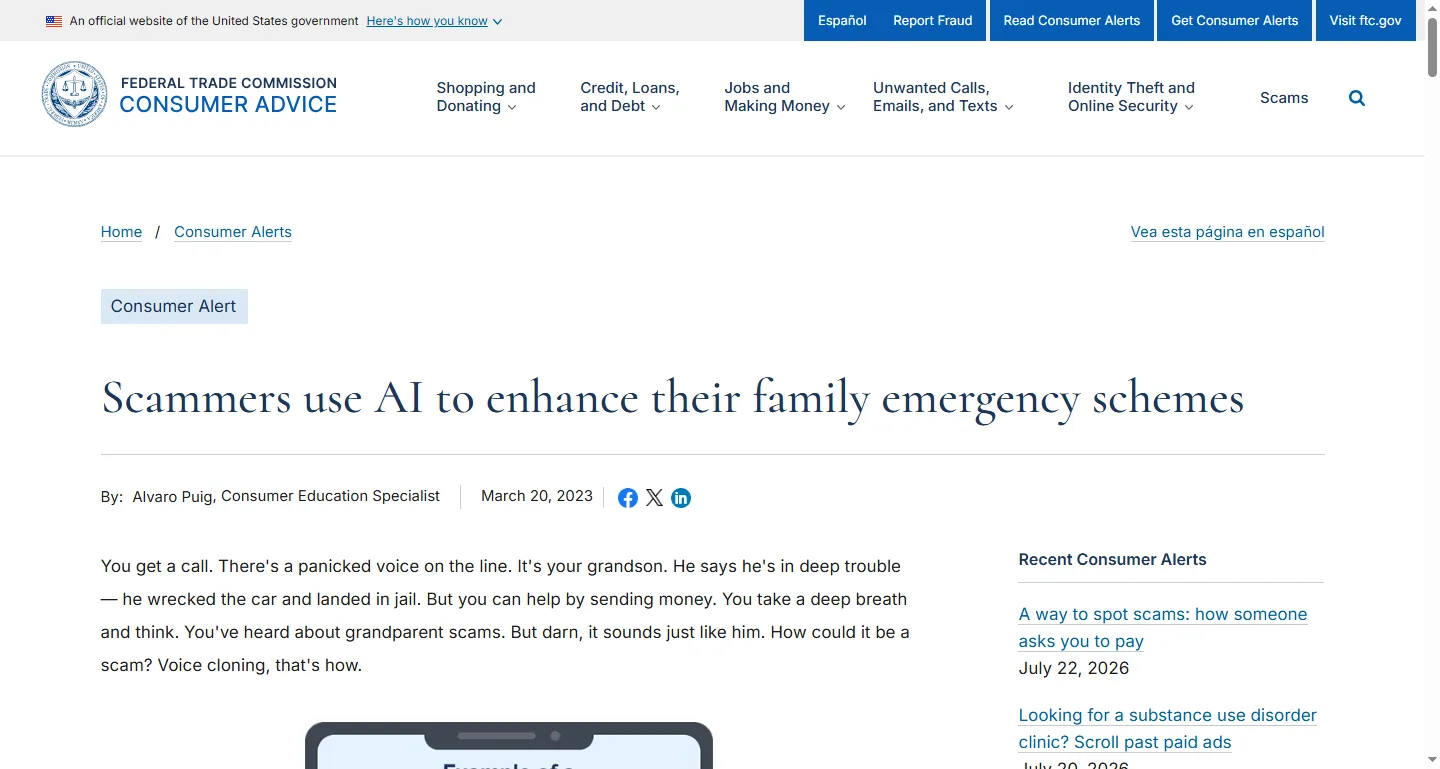
The FTC’s own consumer alert on this exact scam pattern, published years before voice cloning got this convincing.
The FTC has warned about this one directly: scammers pull audio from a public video, voicemail greeting, or video call, feed it to a voice-cloning tool, and generate a call that sounds like your relative in distress. The ask is almost always urgent money through a channel that’s hard to reverse: wire transfer, gift cards, or cryptocurrency.
The tell isn’t in the voice anymore. Cloning tools have gotten good enough that the voice alone won’t save you. The tell is the urgency plus the payment method plus the demand that you act before verifying. Hang up, and call the person back on a number you already had before the call, not one the caller gives you.
That same discipline, verify independently before you act on a convincing pitch, is worth applying outside of scams too. Viral tech products: which ones are worth it runs the same check on shopping ads instead of phone calls.
Fake officials, including fake fraud-recovery sites
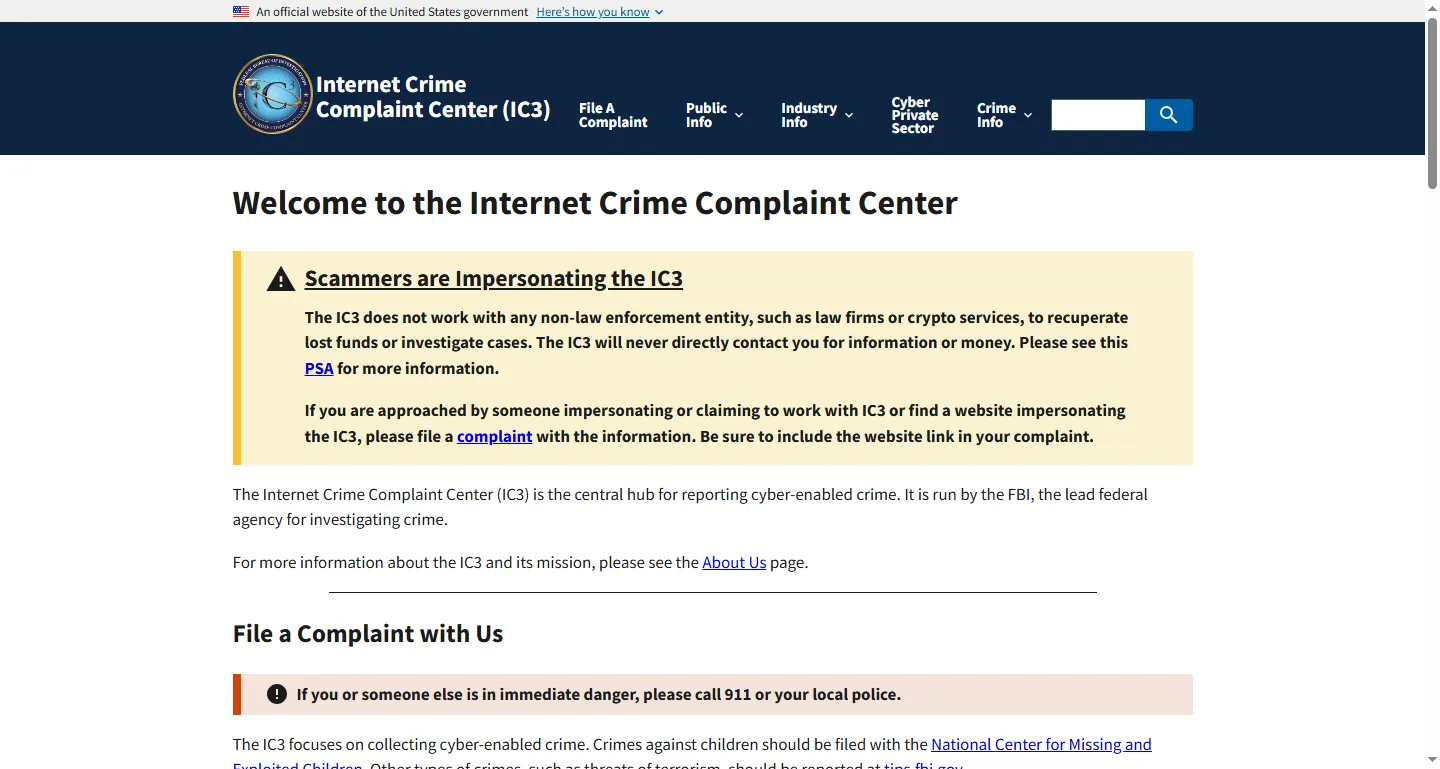
The real IC3 site. Type this address in yourself; don’t trust a link claiming to lead here.
Government and business impersonation together accounted for roughly $1.9 billion of the FTC’s 2025 imposter-scam losses. A newer twist the FBI flagged in a July 2026 advisory: scammers are now specifically targeting people who already reported a scam, posing as IC3 or law enforcement “recovery agents” who can supposedly get the stolen money back, using deepfake video and audio of officials to seem legitimate, and fake lookalike websites to harvest a second round of personal information.
The FBI’s guidance is specific and worth repeating exactly: type ic3.gov directly into your browser rather than clicking any link, and never submit financial or personal details to a site you reached through a text, email, or ad rather than by typing the address yourself.
AI-powered job scams and deepfake interviews
If you’re job hunting, this pattern deserves its own caution. Fake recruiters increasingly use AI-generated LinkedIn profiles and, in the more advanced cases, real-time face-swap filters or cloned voices on video interviews to impersonate a recruiter or hiring manager. Reported deepfake attempts in hiring rose sharply between 2023 and 2024 as the tools got cheaper and easier to run.
The reliable signals: unsolicited contact through an unusual channel (a text or DM instead of your applications), vague job details paired with unusually high pay, and any request for money, gift cards, or banking details before or during onboarding. A real employer never asks a candidate to pay for equipment, training, or “processing.”
Spotting an AI-generated image or video yourself
When you can’t just hang up and call back (a viral video, a suspicious profile photo, a “proof of life” clip), a few checks still hold up reasonably well, though none is fully reliable on its own:
- Background physics: water, fire, smoke, and reflections are still hard for AI to render correctly. Watch how liquids move, not just faces.
- Edges and profiles: when a face turns toward full profile, look for blurring around ears, jawlines that separate from the neck, or glasses that seem to melt into skin.
- Background people and objects: extra or missing fingers, warped furniture, and signage text that shifts or reads as gibberish are still common tells.
- Source and spread: a dramatic clip that exists on exactly one anonymous account, with no other coverage anywhere, is suspicious regardless of how convincing it looks. Ask who posted it first.
None of these checks are foolproof individually. Treat them as reasons to slow down and verify independently, not as proof either way.
Worth it for
- Calling back on a number you already had defeats nearly every version of this scam
- Typing government URLs directly instead of clicking links stops the fake-recovery-site pattern specifically
- Slowing down for even one minute is enough: urgency is the scam's actual weapon, not the AI
Skip it if
- Voice and video authenticity checks alone are no longer reliable: cloning quality keeps improving
- Caller ID and even video calls can now be convincingly spoofed
- Scammers specifically target people who already lost money once, using fake "recovery" help as the second attack
Alternatives
- If a scam attempt came through a browser extension or app rather than a call, the same red-flag mindset applies. See AI browser extensions you should avoid.
- Worried your accounts themselves are the weak point rather than any single call? A password manager with unique passwords limits what a successful scam can actually reach.
- A broader privacy and security cleanup usually pays off more than any single tool. Start with phone settings worth changing immediately.
- Shopping scams are their own category worth checking separately. See how to tell if a shopping site is fake or AI-generated before you enter payment details anywhere unfamiliar.
Verdict
SKIP acting on any unexpected, urgent contact about money, a loved one, or your accounts until you’ve verified it independently, through a number or website you already trust. AI has made these scams sound and look more convincing, but it hasn’t changed what stops them: hang up, look it up yourself, and never let urgency make the decision for you.
Common questions
How can I tell if a phone call is an AI voice scam?
The voice itself won’t tell you anymore. Cloning tools have gotten good enough to copy a relative’s voice from a few seconds of public audio, so the tell is the pattern around it: urgency, a request for money through a hard-to-reverse channel like wire transfer or gift cards, and pressure to act before you can check. Hang up and call the person back on a number you already had before the call, not one the caller gives you. That one habit defeats nearly every version of this scam regardless of how convincing the voice sounds.
How do I spot a fake government recovery scam?
The FBI’s July 2026 advisory flagged scammers posing as IC3 or law enforcement “recovery agents,” using deepfake video and audio of officials plus lookalike websites to harvest a second round of personal information from people who already reported a scam once. The FBI’s own guidance is to type ic3.gov directly into your browser rather than clicking any link, and never submit financial or personal details to a site you reached through a text, email, or ad.